Choosing management software for your repair shop is not a trivial decision. Between generic solutions that lack specific features and specialised tools that only cover part of your needs, the 2026 market presents a fragmented landscape. A poor choice means hours lost every week to double entry, stock errors, and customers waiting with no visibility on their repair status.
This guide objectively analyses the main solutions available for repair shops (phones, computers, electronics, micro-mobility) in France and Europe. We cover essential criteria, the strengths and weaknesses of each player, and the factors that should guide your choice.
Essential selection criteria
Before comparing solutions, you need to define what you expect from repair shop management software. Here are the key criteria:
Repair ticket management
The core of the business. The software must allow you to create a ticket in a few clicks, associate the device, diagnosis, parts used and time spent. Step-by-step tracking (diagnosis, waiting for part, in repair, testing, ready) with automatic customer notifications has become standard. In 2026, good software must also handle multi-device tickets (a customer dropping off several devices) and sub-tickets linked to the same case.
Stock and spare parts management
A repair shop handles hundreds of part references, often by device model. The software must manage storage locations, reorder thresholds, serial numbers/IMEI, and ideally parts traceability (origin, OEM/compatible/refurbished quality). Automatic linking between a ticket and parts consumption prevents billing oversights.
Invoicing and fiscal compliance
Quotes, invoices, credit notes, multi-method payments (card, cash, transfer): invoicing must be smooth and compliant. In France, the software must meet Article 286 CGI requirements (inalterability, security, conservation, archiving). Fiscal compliance is not optional: the fine is 7,500 EUR per non-compliant software.
Traceability and customer tracking
Traceability has become a regulatory issue with the AGEC law and repairability indexes. Good software tracks the complete history of each device: previous repairs, parts used, warranties. On the customer side, an online tracking portal and SMS/email notifications have become essential for customer satisfaction.
Artificial intelligence
This is the differentiating criterion of 2026. AI can assist technicians in diagnosis (suggesting likely faults from symptoms), automatically generate repair reports, optimise stock orders, or answer customer questions via a chatbot. Few solutions genuinely integrate AI natively; most are limited to superficial integrations.
Market solutions
Phonilab
Phonilab is probably the best-known solution among French repairers. Founded by repairers for repairers, it ticks the essential boxes: ticket management, stock, invoicing, and a good customer tracking module with an online tracking page. Strengths: active community, good functional coverage for phone repair. Limitations: the interface lacks modernity, no integrated AI, and the solution remains focused on the French market without a true multi-country dimension.
Hiboutik
Hiboutik is a free POS software (in its basic version) that appeals through accessibility. It is not specifically designed for repair, but its after-sales module allows basic ticket management. Strengths: free for basic functions, easy to use, good POS management. Limitations: repair-specific features (diagnosis, parts traceability, multi-step tracking) are very limited. It is a POS with an after-sales module, not a repair ERP.
GoSuivi
GoSuivi positions itself on repair tracking with a modern interface and a good customer portal. The solution is appreciated for its ease of use and focus on customer communication (online tracking, notifications). Strengths: clear interface, good customer tracking, accessible pricing. Limitations: stock management and invoicing features are less developed than specialised competitors. Better suited to small shops that primarily want to improve customer relations.
SASGESTION
SASGESTION offers a complete suite oriented towards business management with modules for repair. The solution is robust on accounting and invoicing, with good quote management. Strengths: integrated accounting, good fiscal compliance, suited to businesses also doing sales. Limitations: ergonomics are oriented towards business management rather than repair workflow. Field technicians often find the interface too complex for daily use.
Fixaloop
Fixaloop is a newer player betting on a modern interface and mobile-first approach. The solution covers the repair cycle well with particular attention to customer experience (tracking page, integrated Google reviews). Strengths: modern design, good mobile experience, focus on the repairer's brand image. Limitations: relatively young solution, advanced stock and accounting features still under development. Worth watching for its evolution.
RepairDesk
RepairDesk is the international reference solution, very popular in the US, UK and Australia. Functional coverage is broad: tickets, stock with serial management, integrated POS, parts marketplace, multiple integrations (QuickBooks, Xero). Strengths: feature richness, integration ecosystem, multi-site support. Limitations: high pricing (from $99/month), primarily English interface, non-native French fiscal compliance (no SHA-256 chaining, no ISCA attestation). Excellent for English-speaking markets, less suited to French specificities.
Comparison table
| Criteria | Phonilab | Hiboutik | GoSuivi | SASGESTION | Fixaloop | RepairDesk | RepairMind |
|---|---|---|---|---|---|---|---|
| Repair tickets | Complete | Basic | Good | Good | Good | Complete | Complete |
| Stock management | Good | Basic | Limited | Good | Fair | Advanced | Advanced |
| Invoicing | Complete | Good | Basic | Complete | Good | Complete | Complete |
| FR fiscal compliance | Yes | Yes | Partial | Yes | Yes | Non-native | Yes (SHA-256) |
| Parts traceability | Good | No | Limited | Partial | Partial | Good | Complete |
| Online customer tracking | Yes | No | Yes | No | Yes | Yes | Yes |
| Built-in AI | No | No | No | No | No | Basic | Yes (native) |
| Multi-country | France | France | France | France | France | International | FR / UK / BE / CH |
| Multi-site | Yes | Limited | No | Yes | No | Yes | Yes |
| Indicative pricing | ~50 EUR/mo | Free / 20 EUR | ~30 EUR/mo | ~60 EUR/mo | ~40 EUR/mo | ~$99/mo | Coming soon |
Prices are indicative and may vary depending on options and number of users. Last checked: March 2026.
Specialised ERP vs generic software: why it matters
Faced with these solutions, some repairers are tempted to use generic software: a classic ERP (Odoo, Dolibarr), a POS with an after-sales module, or even a combination of spreadsheets and free tools. This is understandable when starting out, but it quickly creates friction.
A repair shop has specificities that generic software does not cover:
- The repair workflow is not a sales workflow. A ticket goes through specific stages (intake, diagnosis, quote, awaiting approval, parts order, repair, testing, return) that sales software does not model natively.
- Parts management must be linked to device models. Searching for a part by model (not catalogue reference) is a daily need that generic ERPs do not handle.
- IMEI/serial number traceability is critical for mobile devices. No generic ERP natively handles IMEI tracking with blacklist verification.
- Technical diagnosis requires a fault reference by device. Generic software lacks an integrated technical knowledge base.
In practice, a shop using generic software always ends up multiplying tools: a spreadsheet for parts tracking, another for IMEIs, a third-party tool for customer notifications. This fragmentation costs time, generates errors, and makes reporting impossible.
The hidden cost of a poor choice
Based on repairer feedback, unsuitable software wastes an average of 45 minutes to 1 hour per day on double entry, information searching, and manual management. Over a year, that represents more than 200 lost hours — not counting invoicing errors and unbilled parts.
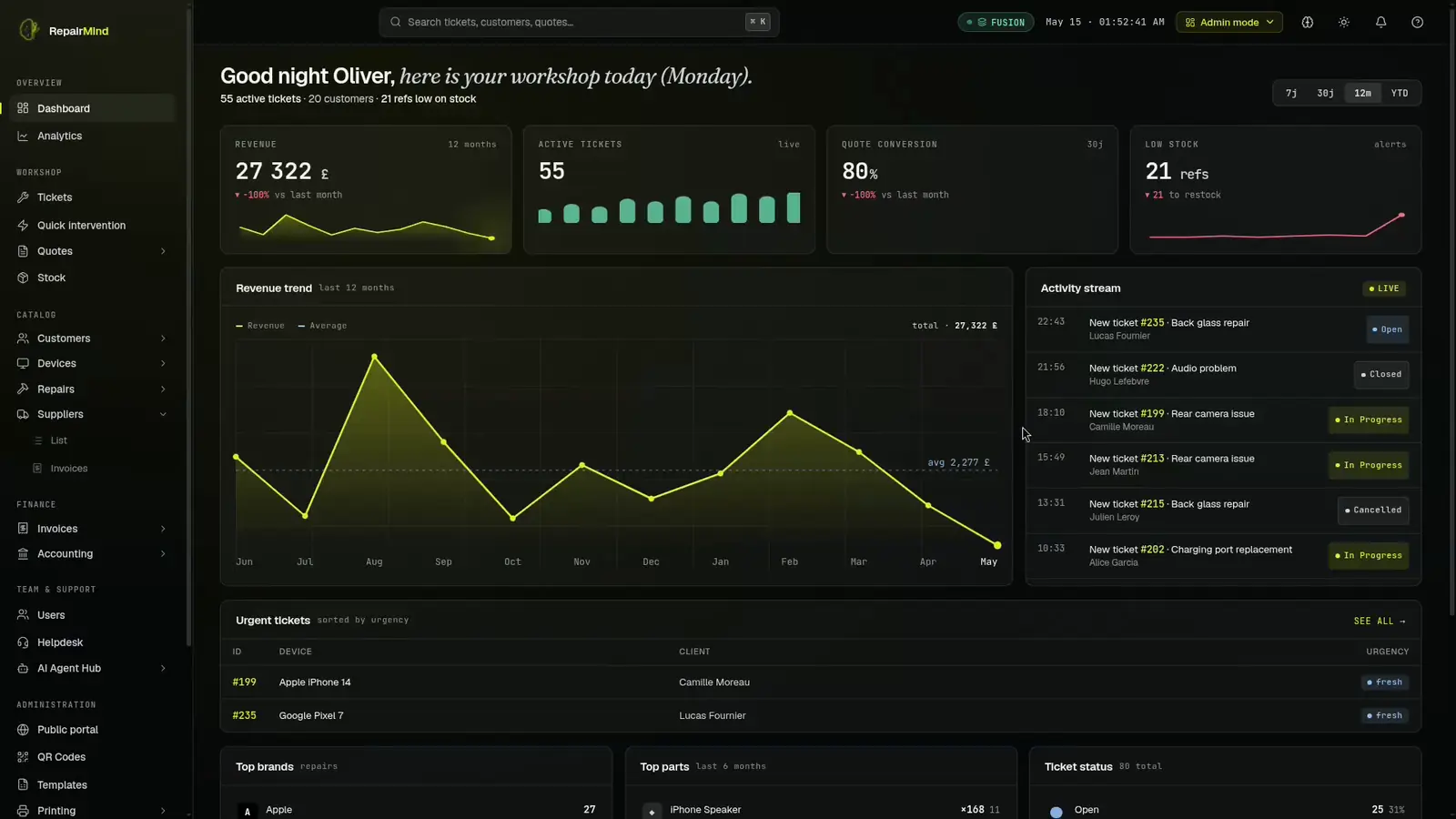
RepairMind — the next-generation ERP for repairers
RepairMind was born from a simple observation: no existing software fully met the needs of a multi-activity repair shop in 2026. The project was created by a repairer, for repairers, with a fundamentally different approach.
Native artificial intelligence
AI is not a gadget bolted on after the fact in RepairMind. It is integrated into every module:
- Diagnosis assistance: from symptoms entered by the technician, AI suggests the most likely faults based on the shared knowledge base (fed anonymously by all workshops).
- Report generation: the technician enters technical notes, AI generates a clear, professional report for the customer.
- Stock prediction: by analysing repair history, AI anticipates parts needs and suggests orders.
- Built-in MCP server: a conversational AI agent can query the entire system in natural language (stock, tickets, revenue, fiscal compliance).
Built by a repairer
RepairMind was not designed by developers imagining what a workshop's daily life looks like. It was designed by someone who lived the problems every day: the part forgotten on a ticket, the customer calling to check on their repair, the daily cash close that does not balance. Every feature addresses a real problem encountered in the workshop.
Isolated multi-tenant architecture
Each workshop has its own completely isolated database. Your data is never mixed with another workshop's. In parallel, a shared knowledge base (device references, known faults, parts compatibility) is collectively maintained and benefits the entire network.
Built-in fiscal compliance
RepairMind natively integrates SHA-256 cryptographic hash chaining, RSA signing of fiscal documents, automated daily closures, and automatic compliance attestation generation. The fiscal module is multi-region: France (ISCA), United Kingdom (Making Tax Digital), and Belgium (PEPPOL).
Multi-country, multi-currency
RepairMind is designed from the ground up to work in France, Switzerland, the United Kingdom, and Belgium. The interface is available in French and English, and currencies (EUR, CHF, GBP) and fiscal rules automatically adapt to the tenant's region.
How to choose: the questions to ask yourself
Rather than telling you which software to choose, here are the questions that should guide your decision:
- How many repairs do you handle per month? Below 50, a simple tool like GoSuivi or Hiboutik may suffice. Beyond that, a specialised ERP becomes worthwhile.
- Do you manage a significant parts inventory? If so, advanced stock management (multi-location, thresholds, traceability) is non-negotiable.
- Do you have multiple locations? Multi-site radically changes the choice: few solutions handle it correctly.
- What is your market? France only or international? Fiscal compliance and interface language are determining criteria.
- What monthly budget? Watch for hidden costs: some software charge for additional modules, extra users, or support.
Our advice
Test at least two solutions before committing. Most offer a free trial or demo. Involve your technicians in the test: they are the ones who will use the software daily. Powerful software that the team refuses to use is a wasted investment.
Discover the ERP built by a repairer
RepairMind combines native AI, multi-country fiscal compliance, and ergonomics designed for daily workshop use. Request a demo to see how it fits your workshop.
Request a demo