Repair has never had more momentum. Repairability index, repair bonus, right to repair, and customers who want to keep their devices longer. Opening a shop is an achievable project, as long as you frame the right steps. Here is how to go from idea to opening day without unpleasant surprises.
Choosing Your Specialty
First, define what you are going to repair. That choice shapes your tooling, your stock, and your customer base. Three main directions stand out.
- Mobile phones: smartphones and tablets. High volume, moderate average order value, fast turnover.
- Computers: laptops and desktops. Longer tickets, often higher margins.
- Multi-device: phones, computers, consoles, small connected gear. More versatile, but requires more tooling.
The most useful advice for getting started: begin focused, on a scope you master, then expand once your first flows are in place.
Legal Status and Formalities
Two options come up most often when opening an electronics repair shop.
- Sole trader (micro-entreprise): simple, ideal for testing your market. Revenue ceiling, no VAT recovery.
- Company (EURL, SASU): more formalities, but VAT recovery and better protection of your personal assets.
In both cases, plan for registration and professional liability insurance. Have your choice validated by an accountant: it is the most profitable upfront investment you can make.
Budget and Starting Equipment
Costing your project means listing each line item, then making trade-offs. Here are the main ones.
- Premises: a high-traffic location for walk-in customers, or a more discreet space if you work by drop-off and shipping.
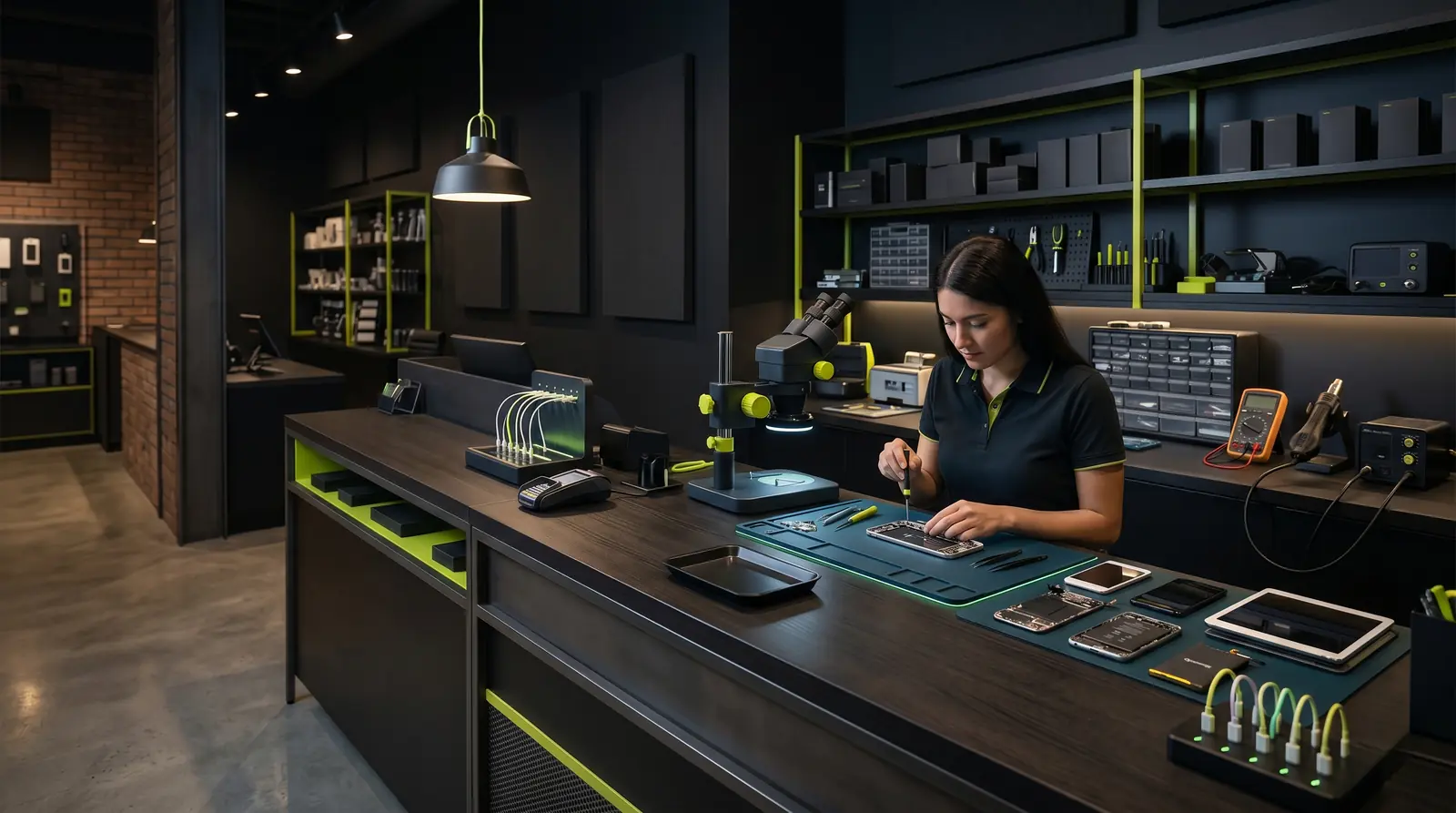
- Tooling: soldering and microsoldering station, lab power supply, microscope, opening tools, multimeter.
- Parts stock: screens, batteries, and connectors for the most common models.
- Payment: a payment terminal and compliant point-of-sale software.
- Office: a workstation, a label printer, a receipt printer.
Start lean
There is no need to buy everything on day one. Start with a tight stock of the parts that really move, then grow your catalogue based on real demand. You tie up less cash and you learn what actually sells.
Equipping Yourself With Management Software
Good software centralizes everything that would otherwise end up scattered across a notebook, text messages, and a spreadsheet: repair tickets (intake, diagnosis, repair, handback), inventory and orders, quotes and invoices, and customer relations.
RepairMind goes further: it is the AI suite for repairers, with an ERP at its core driven by an agent that handles supplier invoice entry, email sorting, and follow-ups. You stay in control, the AI handles the admin.
Compliance and Obligations
Opening a shop also means respecting a framework. The points to know from the start.
- Compliant point of sale: tamper-resistance, security, retention, and archiving of payments, through an ISCA self-certification (article 286 of the French tax code).
- Parts traceability: a clear link between each part, its purchase invoice, and its warranty.
- Warranties: inform the customer about the warranties that apply to the repair.
- Repair bonus: if your shop is certified, it can be deducted directly on the customer's invoice.
Finding and Keeping Your First Customers
A shop cannot live without flow. Three levers make the difference at launch.
- Local presence: an up-to-date business listing, reviews, and a clear storefront on what you repair.
- Speed and transparency: a quick quote and SMS tracking reassure customers and trigger the decision.
- Word of mouth: a clean, guaranteed repair remains your best advertising.
Software that automates tracking and follow-ups helps you keep those promises without spending your whole day on them.
FAQ
How much does it cost to open a repair shop?
It depends on the premises and the tooling, but an electronics repair shop remains one of the most accessible businesses to launch. List your line items (premises, tooling, stock, software) before pricing it out.
Which legal status should I choose for a repair shop?
Sole trader status to test simply, a company to recover VAT and protect your assets. To be validated with an accountant.
Do I need a diploma to open a repair shop?
No diploma is required to open an electronics repair shop, but technical skill makes the difference. Some schemes, however, require a certification.
Which software should I use to run a repair shop?
A tool that brings together tickets, stock, invoicing, and a compliant point of sale. RepairMind adds an AI agent that takes care of the admin.
Ready to open your shop?
RepairMind is the AI suite designed for repair shops: tickets, stock, compliant invoicing, and an agent that handles the admin. Everything you need to start on solid ground.
Request a demo