What if AI handled everything but the repair?
An independent repairer spends an enormous share of their time on everything that is not repair: stock, invoices, supplier orders, follow-ups, accounting. Time stolen from the only thing that saves a device — the technical work itself. This page is about what we are building to change that, where we stand today, and where we want to go.
The starting point: the trade doesn't lack work, it lacks people
Repair demand is there. What is missing are people able to absorb it — because the barrier to entry is double. There is the technical skill: going from "I can swap a screen" to "I can diagnose a motherboard" takes years, and that path is almost always walked alone. And there is the complexity of running a business: a brilliant technician can drown in admin.
Our bet: AI can lower both barriers at once. Not by replacing the repairer — physical repair needs hands, AI does not desolder a BGA — but by transmitting the knowledge they lack and absorbing the load that crushes them.
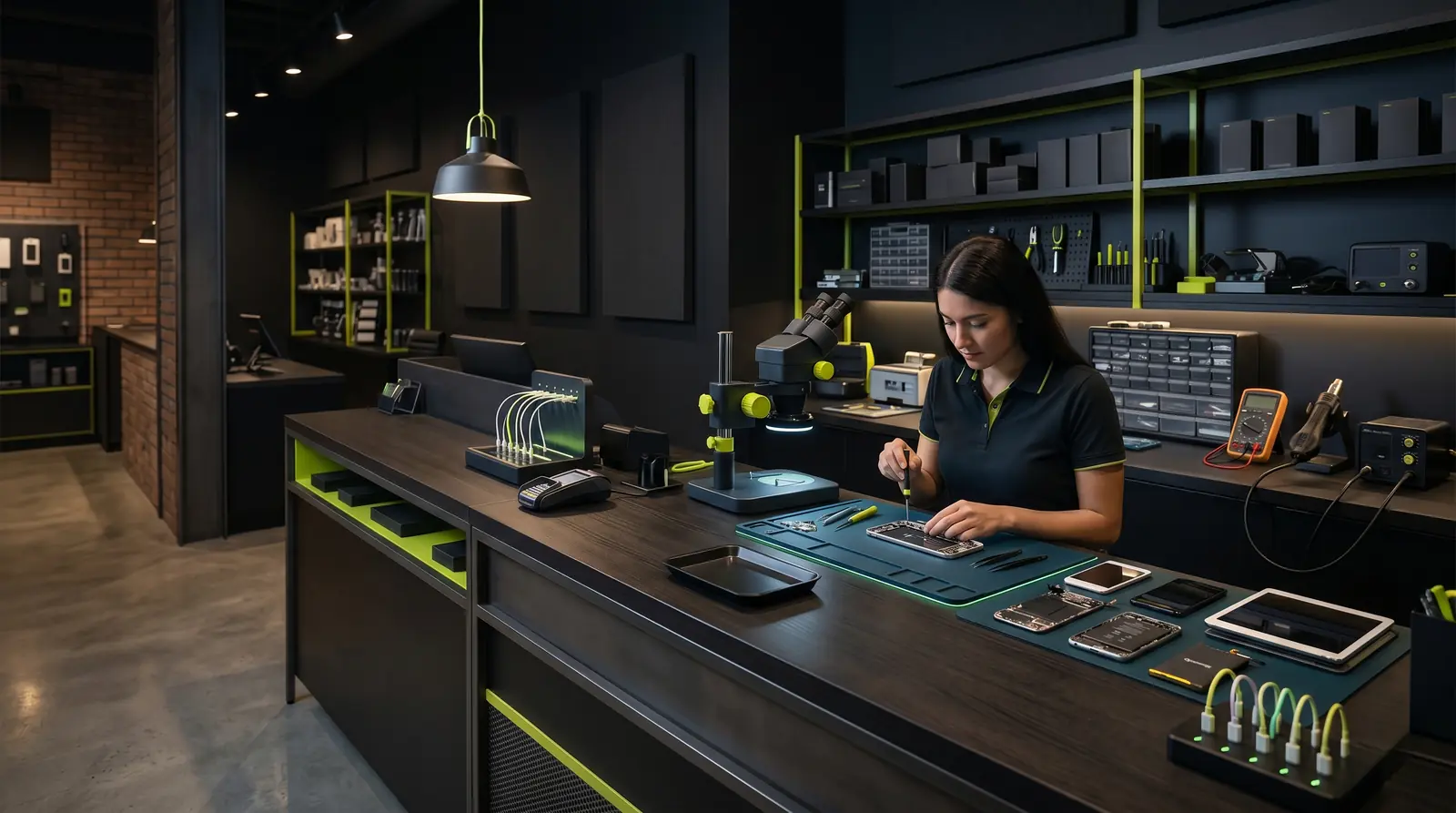
Today: admin on autopilot
That is the role of RepairMind, our ERP for repair shops, built over more than three years from the real daily routine of a workshop. AI is integrated natively, exactly where time gets lost: an agent that answers by voice and acts across the whole ERP, supplier invoices extracted automatically, customer follow-ups handled by SMS, a shared knowledge base that spares you from retyping everything.
The goal is simple to state and long to build: a technician working alone should be able to run a shop — even a small business — without collapsing under the administrative burden.
The twin: Wrench Board, AI on the bench
The other half of the trade is diagnostics. In board-level electronics repair (micro-soldering), the learning curve is brutal: every device model has its own architecture, a senior carries it in their head after years of repetition, and the independent technician faces all of it alone.
Wrench Board is our answer: a bench teammate for board-level repair. Give it a device's schematic and boardview, and it builds a device-specific knowledge pack in about two minutes; then an AI diagnostic agent drives the board visually with you — pins highlighted, nets traced, measurement protocols — while you keep the soldering iron in hand. The project took second place at Anthropic's "Built with Claude" hackathon, among 500 builders selected from over 20,000 applicants.
A senior's knowledge in a junior's hands
Becoming a capable board-level technician takes years of struggling alone. With an agent that holds your hand through your first diagnostics and explains why a line is suspicious, that learning curve compresses. It is not a replacement — it is a transmission.
Tomorrow: one flow, from diagnosis to invoice
Both projects were born from the same hands and are converging: integrating Wrench Board into RepairMind is on our roadmap. Board-level diagnostics plugged into the shop's full workflow — ticket, stock, quote, follow-up, invoicing. An end-to-end repair stack, built for independents.
Further out: repair as a simple gesture
Beyond the tools, there is a conviction about what a healthy repair ecosystem should look like within five years. One image guides us: the repair locker. A customer drops their device in a kiosk, a first diagnosis is made, and the fault is routed intelligently — a simple repair to a generalist, a motherboard fault straight to a competent micro-soldering workshop. The repairer receives a qualified stream of work instead of losing hours on free diagnostics for devices they cannot fix.
It is a vision, not a product — but it is the direction: making repair as simple a gesture as dropping off a parcel, without ever disintermediating the repairer.
Why it matters: 62 million tonnes
The world generated 62 million tonnes of electronic waste in 2022. The UN expects 82 million by 2030 — with less than a quarter properly recycled — and explicitly cites the lack of repair options among the causes. Every board diagnosed and repaired instead of discarded means less pressure on raw-material extraction and one less device in the waste stream.
That is also why we stand with the right to repair: AI is a powerful multiplier, but it multiplies what you give it. As long as schematics and boardviews stay locked down by manufacturers, every independent technician has to painstakingly rebuild knowledge that already exists. The "too complex to repair" argument collapses once the tooling exists — what remains is the protection of the replacement market.
Built from the workshop
All of this comes from lived experience: years spent in an independent repair shop in southwestern France, repairing electronics — and watching the hours disappear into everything that was not repair. The tools we build are the ones that were missing behind that counter. That is our compass: every hour given back to the technical work is an hour won for the trade, for the customer, and for the devices we save.
Let's build it together
RepairMind is the ERP of this vision: admin on autopilot, starting today. And for board-level diagnostics, discover Wrench Board.
Request a demo